Why Your Cat Chose You, According to Edgar Cayce
A calm look at the old belief that cats are spiritual companions, from Egypt to Edgar Cayce, and what their behavior may be quietly telling you.
Have you ever wondered why cats stir such a peculiar feeling in us? Some people feel an instant bond with them. Others feel a mixture of fascination and unease. I think the answer is buried in thousands of years of human history, in a time when these animals were far more than pets.
Let me walk you through that history, and then through what Edgar Cayce is said to have taught about cats. I will tell you plainly where I am describing a tradition or a belief, and I invite you to hold it the way you would hold a story told by a wise elder: with respect, and with your own judgment close at hand.
Sacred creatures of the ancient world
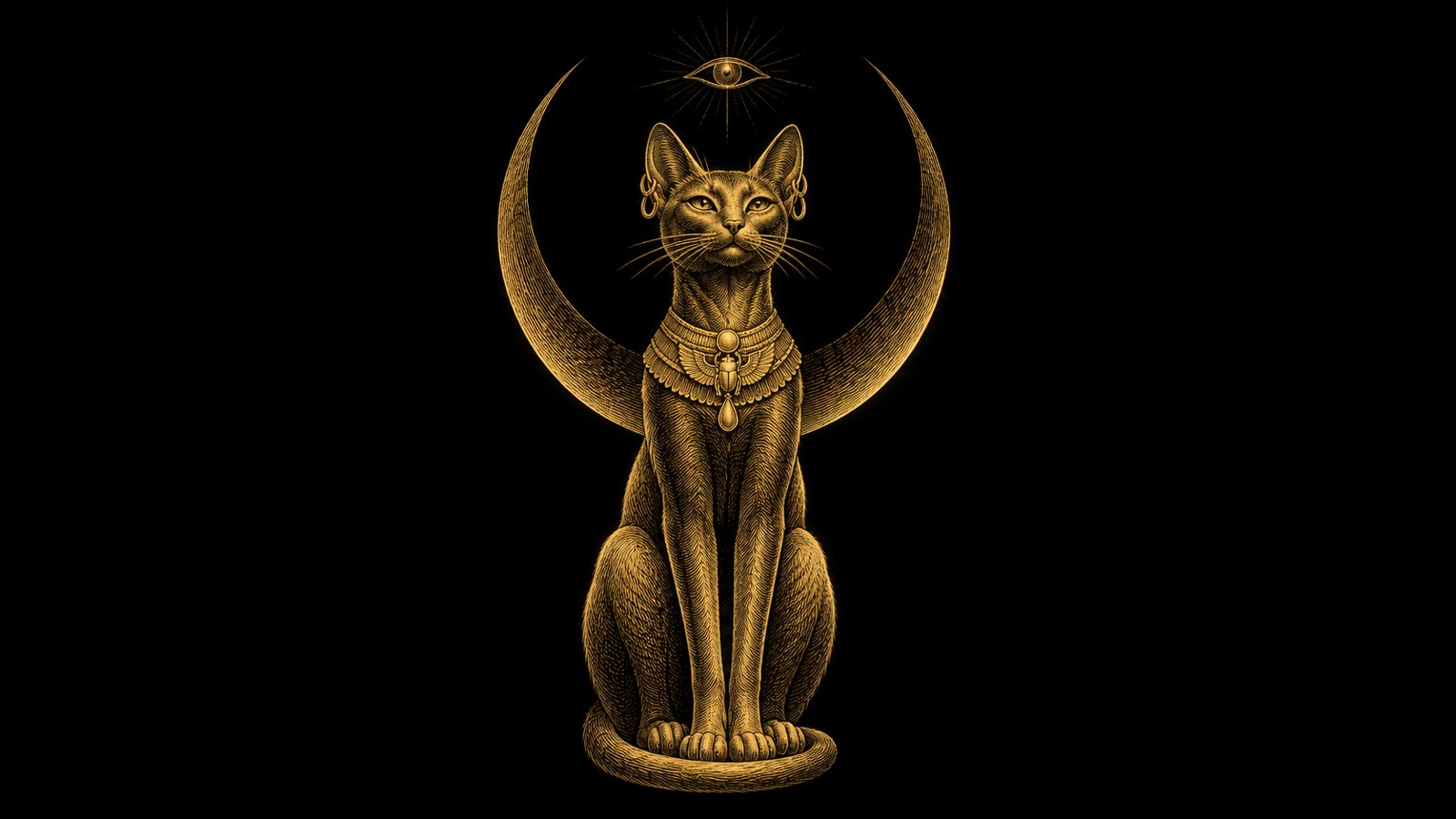
In ancient Egypt, killing a cat was a crime punishable by death. That was not a quirk of one civilization. It reflected a deep reverence. The Egyptians saw cats as living bridges between the physical and the spiritual worlds. The goddess Bastet, shown with the head of a cat, stood for protection, intuition and the ability to see beyond the veil.
Egyptian priests, we are told, watched the cats in their temples and noticed something strange. The animals stared at empty corners, reacted to things no one else could see and behaved as if they were in company. When a household cat died, the family would shave their eyebrows in mourning. Cats were mummified with great care, and archaeologists have found whole cemeteries filled with feline mummies, buried with amulets and offerings.
The reverence was not only Egyptian. The Celts are said to have regarded cats as keepers of ancestral secrets, able to move between the world of the living and the world of the dead. At Samhain, the festival we now remember as Halloween, cats were seen as messengers carrying something from the beyond to those who knew how to read the signs. In Norse myth, the goddess Freya rode in a chariot pulled by two great cats, symbols of independence, mystery and hidden forces.
Many people who love these traditions say that the ancients noticed something we have mostly forgotten: that cats seem tuned to a quieter layer of the world. In the Middle Ages, that old respect turned into fear. Cats came to be linked with witchcraft, perhaps because they were such natural companions for people who lived close to nature and its subtle rhythms. Whatever the cause, the persecution of cats was a loss, for them and for us.
So when a cat appears in your life today, it arrives carrying all of that heritage. It may be looking for food and a warm place, of course. But those who hold this view believe it is also responding to something in you.
What Cayce said about cats
Edgar Cayce was born in 1877 on a farm in Kentucky. As a child he showed unusual gifts, and he later became known for giving readings in a deep trance, often about health, for people he had never met. What made him distinctive, his followers say, was that he rarely saw an illness as only physical. He looked for its emotional and spiritual roots as well.
Among the material attributed to Cayce is a view of cats as companions who serve a purpose. In one account, he is said to have told a woman struggling with chronic depression that the cat in her home was acting as a kind of filter, softening heavy atmospheres around her. The idea was that this was not an accident. It was a role the animal had taken on.
Cayce is also described as speaking of an expanded subtle body in cats, a wide field around them, and of the way a cat approaches a person by first "reading" them: not only their mood today, but something of their deeper story. Asked why some cats seem to choose particular people, he is said to have answered that certain animal souls come with a purpose of staying close to certain human souls, which is why the recognition can feel instant.
His teaching also touches the purr. In this telling, a purr is not only contentment. It is a steady, soothing vibration that helps calm a person and invites a feeling of peace. I will leave the technical claims to the experts. What I can say is that many people feel their shoulders drop when a cat purrs beside them, and that feeling is real enough.
One more thing attributed to Cayce is hopeful. He is said to have foreseen a time when people would rediscover the spiritual side of animals, as they themselves began to wake up to a larger sense of who they are.
How a cat reads you
Have you ever felt that your cat knew how you were feeling before you did? Many of us have. Part of this has everyday explanations. When you are anxious, your body changes, and a cat's senses are sharp enough to notice. Part of it, the spiritual traditions would say, goes beyond the senses we usually count.
Notice what happens when you are going through something hard. Often the cat comes closer. It purrs more, or simply stays near, without demanding anything. Some people believe that cats are sensitive to the gentle shifts in our emotions and in our energy, and that they respond by offering a quiet kind of company.
Others observe that cats seem to sense change before it arrives: a cat acting differently days before bad news, a move or an illness. And some cat lovers say different colors seem to carry different temperaments, from the black cat who is calm in heavy moods to the tabby who steadies a household. Take these as the gentle folklore they are, not as rules.
It also works the other way. The more time you spend with your cat, the better you become at reading it. Many owners sense when something is wrong long before any sign shows.
Signs that you have been chosen
According to this tradition, a cat decides you are its person well before it moves into your home. People point to a handful of behaviors that tell the story.
- A long, soft gaze. Slow eye contact, especially at a first meeting, often with slow blinks.
- Selective approach. In a room full of people, the cat walks straight to you.
- Rubbing against you. A greeting that leaves its scent, and is usually followed by purring or settling close by.
- Matching your breath. Lying nearby and slowly falling into your rhythm.
- Showing its belly. For a cautious animal, this is a sign of real trust.
- Mirroring your mood. Coming close when you are sad, giving you space when you need it, playing when you are happy.
- Choosing where to rest. Settling where it can see you, or between you and the door.
- Curling up on you. The final gesture of acceptance.
Some people also tell of an odd pull toward a shelter, a street, or a dream of a cat they had not yet met. If that has happened to you, you will know exactly what I mean.
Seven kinds of purpose
Cayce's readings, as the tradition tells it, suggest that cats come into our lives with different roles. Here are seven, offered as ways of seeing rather than as facts.
- The healer. The cat that lies on the aching spot, or beside your heart when you are sad.
- The guardian. It watches the house, stares into empty corners, and avoids certain places.
- The teacher. It seems to draw your attention to small signs, and to the value of stillness.
- The one who stirs old memories. It reacts strongly to certain places or moments that touch something unresolved in you.
- The balancer. It settles near the most upset person during tension in the family.
- The doorway. It seems to notice what you cannot, and deepens quiet moments of prayer or meditation.
- The accelerator. It tends to show up when you are working on a big change.
A cat may carry more than one of these, and its role may shift. It might come as a healer in an illness and later become a teacher when you are ready for more. Watch its patterns over time, and you will likely sense which one it is.
Reading the small messages
If you wish, you can treat your cat's habits as a gentle language.
Where it sleeps may say something about the mood of your home. A cat that avoids a room may be reflecting a heaviness there; one that sits near a window may be pointing you toward something coming. Night patrols may be its way of tidying the day, and if it wakes you between three and five in the morning, many traditions call those hours quiet times when messages come through most clearly.
Changes in eating can mirror changes in you. Gifts of toys remind us that giving and receiving belong together. Kneading is seen as a kind of massage, and slow blinking as a caress from across the room. Short, urgent meows ask for attention; long, musical ones may be an attempt to soothe. A cat that hides from a visitor may simply be telling you something about that visitor.
You do not need to accept any of this as fact. A simple practice is enough: keep a small notebook, jot down what your cat does and what happens in your life, and see whether a pattern appears.
A quiet closing
Whether you believe that cats are guardians from another plane, or you simply love an animal that sits with you in the evening, the relationship asks the same of you: attention, gratitude and gentleness. Perhaps being chosen means nothing more mysterious than this: someone trusted you with their sleep. And that, on any ordinary night, is already a kind of grace.
Quantum Entanglement, the Subconscious and the Energy You Carry
A calm look at quantum entanglement as a metaphor for how thoughts, emotions and the subconscious may shape the life we experience.
Read →
How to Remember Your Soul Contract and Your Life's Mission
Signs, patterns, gifts and quiet practices that many spiritual traditions say can help you rediscover the purpose your soul chose before birth.
Read →
Edgar Cayce's Prophecy About Dogs and the Awakening of Our Companions
A reflective look at a prophecy attributed to Edgar Cayce about dogs as spiritual companions, and the stories people tell of their pets.
Read →