What Your Soul May Experience While You Sleep
A gentle look at what spiritual traditions say happens to the soul during sleep: the three planes, the silver cord, lucid dreams and simple nightly protection.
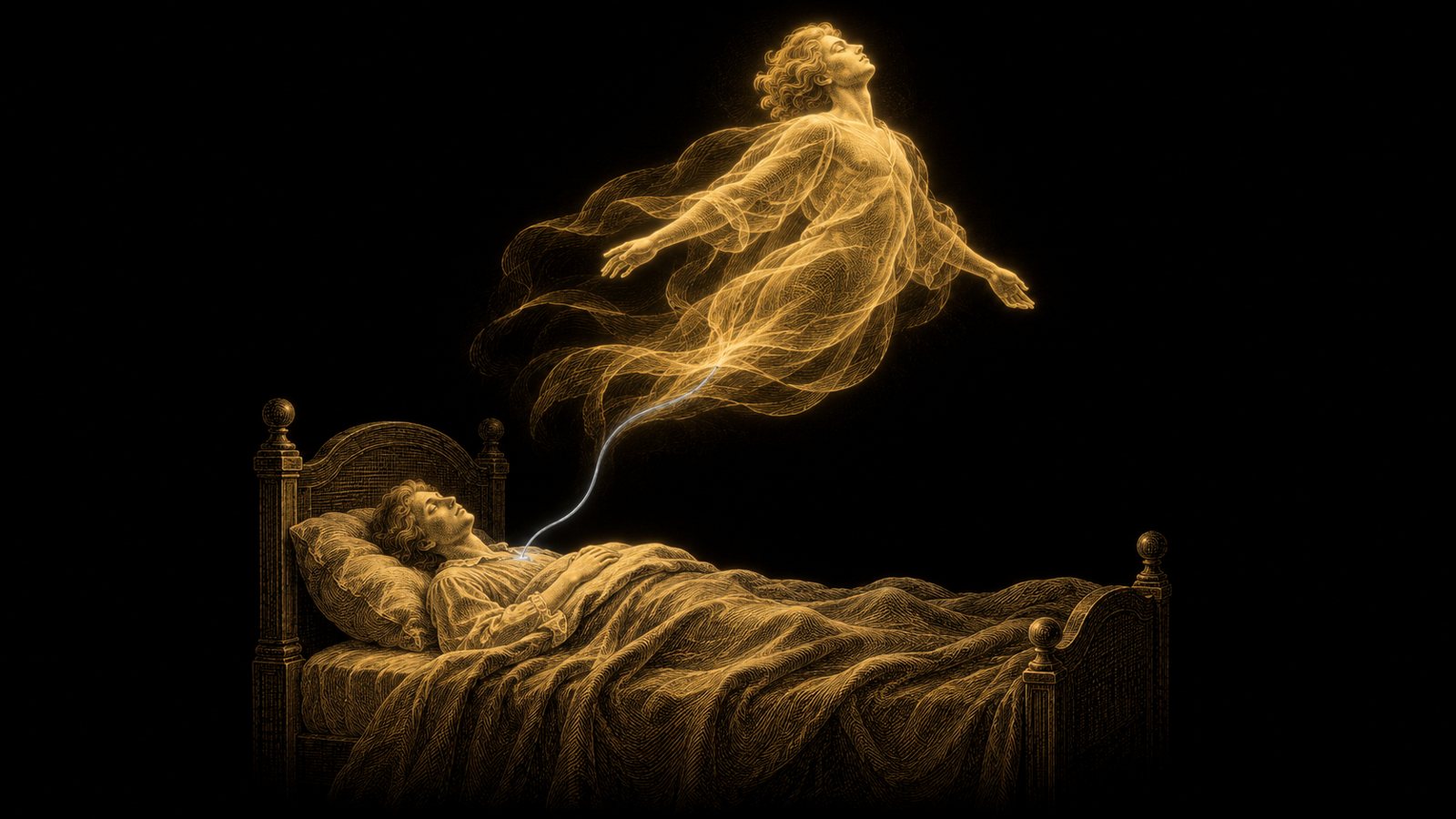
What happens at the exact moment you drift off? Those seconds when your awareness slips away and you enter what we call sleep. Most of us treat it as a blank: the body rests, the mind switches off, and morning arrives.
Many spiritual traditions describe it very differently. They say that when you close your eyes, your soul is not resting at all. It is preparing for a journey. I do not claim to prove this. I want to share the picture as it has been described, and let you decide what to keep.
A third of your life
If you live to seventy-five, you will spend about twenty-five years asleep. It is fair to ask whether nature would set aside so much time merely for rest. The traditions answer that these hours serve spiritual development, healing, and connections that go beyond ordinary life.
You may remember, from childhood, waking with the feeling that you had lived an entire life during the night, or dreams so vivid they seemed more real than the day. In this view, such dreams are fragments of what the soul truly experienced elsewhere. The body is a temporary vehicle, and in sleep the essence is freer.
Have you ever woken with the answer to a problem that tormented you the day before, or with a sudden certainty about what to do? The explanation offered is that, while the filters of the senses fall quiet, the soul has access to knowledge your waking mind cannot easily reach.
The gradual separation
There is a moment, falling asleep, when you may feel yourself dropping or sinking into the bed. Many traditions read this as the soul beginning to loosen from the body. They describe the process in stages. First, you lose touch with the senses: the sounds of the room, the temperature of your skin, the weight of your body. It is as if someone were turning down the volume of the world. As physical perception fades, spiritual perception is said to grow.
Then comes what the ancients called etheric separation. Think of wearing a tight spacesuit all day and finally taking it off. The process is said to take twenty to forty-five minutes, depending on how relaxed you are. On the shallowest level, the soul stays close to the body, floating just above it, and this is where most ordinary dreams occur, mixing the day's memories with symbols. In deeper separation, the soul is described as free to travel, unbound by distance. Dreams of flying or moving in impossible ways are, in this telling, real memories of that freedom.
Because you remain connected to your body, you cannot get lost. Your soul, the story goes, always finds its way home.
The quality of the journey depends on the state you carry to bed. Going to sleep angry, afraid or anxious is said to bring heavier nights. Peace and gratitude bring healing ones. Whether or not you accept the spiritual language, I think most of us can confirm that we sleep differently after a good evening than after a bitter argument.
Three planes of the night
The traditions describe three layers the soul may move through.
The physical etheric. This is close to ordinary reality, with familiar places and people, but a little bent: your childhood home with extra rooms, or an old friend in an impossible setting. It is also described as a place where sleeping souls can meet. Have you ever dreamed about someone, and the next day they said they had dreamed about you too?
The intermediate astral. A realm governed by emotion, desire and thought, where intention creates instantly. Here come the epic dreams, the heroic adventures, and the nightmares. They are seen as chances to process inner conflict. The tradition also says it is inhabited by other beings, some of whom are souls who have died and not yet moved on, and some of which are not kind. That is why some mornings you wake drained, as though you had been fighting all night.
The higher mental, also called the plane of the Akashic records. Here the soul is said to reach knowledge that goes beyond personal experience: memories of past lives, guidance, universal truths. It is not dreaming in the usual sense. It is more like direct understanding. People often speak of Tesla, Einstein and Kekulé as having received insights through dreams or altered states. You usually wake from this plane not with a story but with a deep sense of peace, a new understanding, or a certainty about which direction to take.
Which plane you visit depends, in this view, on what you need. During emotional healing you might spend more time in the astral. When seeking answers, you are drawn to the higher mental. Each night offers what has been called three spiritual universities.
The silver cord
Linking soul and body, the traditions describe a silver cord. It is imagined as a safety line, like the rope of a mountain climber, joined near the solar plexus or heart and pulsing with your heartbeat. It also carries what you learn at night back into the body.
In a healthy, balanced person, the cord is said to shine and be flexible. In someone ill or distressed, it may appear dull or thin. Stress and anxiety might make it tense, as if the body kept pulling the soul back from where it needs to go. People who have had near-death experiences often describe a luminous cord and the sense of being pulled back to life. Physical death, in this teaching, happens when the cord is finally and permanently severed, usually gradually.
I should be careful. These are descriptions from spiritual traditions, not findings from medicine, and none of them should be used to explain real symptoms like persistent exhaustion or disturbing dreams. If those trouble you, speak with a doctor.
Fear of the dark corners
Some teachings go on to speak of beings that feed on human emotions, often called astral parasites or energy vampires, and say that sleep is when we are most open to them. They are said to draw on fear, anger and despair, to bring nightmares, and to leave a person exhausted. Sleep paralysis with a sense of a presence in the room is sometimes interpreted this way. I would offer a more grounded view as well: sleep paralysis is a known experience in which the body stays still while the mind wakes, and it is frightening but not dangerous.
I mention these ideas because they exist, and because they explain why protective rituals are so old. But I do not think it helps to approach the night with dread. Even within these traditions, the central point is that fear is the thing that makes us feel vulnerable, and that you have far more power than any shadow.
Becoming aware in the dream
A lucid dream is one in which you realise you are dreaming. The traditions treat it as a way to take part in the soul's journeys: seeking guidance, meeting your higher self, practising a conversation, or forgiving someone in the safety of a dream.
A few simple techniques are suggested:
- Reality checks during the day. Ask yourself, "Am I dreaming?" Look at your hands, read some text twice, notice whether it stays the same.
- Intention before sleep. Quietly repeat, "When I dream, I will realise I am dreaming."
- Early morning. Waking naturally and then returning to sleep is a good moment for first experiences.
- Staying calm. If excitement threatens to wake you, rub your dream hands together or look closely at a detail.
There are cautions as well. Some people grow so fascinated that they neglect their waking lives, and the traditions advise balance and respect. It takes patience, and some people need months.
Simple nightly protection
If you wish to prepare the night, the practices offered are gentle and mostly familiar:
- Tidy the bedroom and remove objects that carry painful memories. Open a window to let fresh air in.
- Some people place crystals such as amethyst or rose quartz nearby, or burn incense, or keep a glass of water by the bed.
- Visualise a soft white or golden light surrounding you and your bed for a few minutes.
- Say a short prayer in your own words, asking that only love and light approach, and that your soul be guided toward growth.
- Name three good things from the day. Gratitude is said to be among the most protective states.
- Avoid horror films, upsetting news and arguments before bed. Choose soft music or quiet reading.
If you wake frightened, repeat firmly, "I am light, I am love, I am protected." Even outside any belief, those words have a way of slowing the heart.
A changing time
The teaching ends with a sense of urgency, saying that humanity's consciousness is rising and that the boundary between planes is thinning. I would not take that as a reason to be afraid. Whatever the truth, the night is a third of your life, and it deserves your attention.
A closing thought
Whether sleep is the soul's journey or the brain's quiet work, it is something we can enter with care. Go to bed more softly tonight. Let the day's anger settle, name what you are grateful for, and let the dark be a place of rest. Perhaps in the morning you will wake lighter, with a small piece of understanding you did not have before.
Quantum Entanglement, the Subconscious and the Energy You Carry
A calm look at quantum entanglement as a metaphor for how thoughts, emotions and the subconscious may shape the life we experience.
Read →
How to Remember Your Soul Contract and Your Life's Mission
Signs, patterns, gifts and quiet practices that many spiritual traditions say can help you rediscover the purpose your soul chose before birth.
Read →
Edgar Cayce's Prophecy About Dogs and the Awakening of Our Companions
A reflective look at a prophecy attributed to Edgar Cayce about dogs as spiritual companions, and the stories people tell of their pets.
Read →